Therapy Technique of the Week: Story Building Pt 2

We are on week two of story building for pragmatics and social communication. We’ll call this kid Ko. Ko is about 6 years old. He receives special education in a self-contained classroom with other children with autism. 

Important notes about why stories became important for Ko:

The good

Has extensive language, using full, grammatically correct sentences.

Has a good grasp of his surroundings, including people and events and likes to participate in sports and musical activities.

The bad

Doesn’t use I statements.

Uses only sounds but no language while pretend playing.

The ugly

Is very distractible, spending most of his day wandering away from classroom activities to spin in circles or talk to himself.

Can become very aggressive or engage in elopement behaviors in the name of humor.

Note: I hold no true belief in bad or ugly behavior when it comes to autistic children and existing maladaptive tendencies – this phrasing is purely for creative writing.

So what did we do about this? We didn’t quite make it to the level of telling a social story but these things helped target the skill.

Activity 1: the therapist prompts, Tell me something about yourself. While taking turns throwing a ball or similar task, the child remains engaged and motivated to respond in order to throw the ball back.

Activity 2: The therapist prompts, tell me something about your friend. Directing attention to an outside person is easier than directing attention to themselves. Still, verbalizing an appropriate quality is learned so models help.

Activity 3: Modeling a story with a character and a problem, using the manipulatives. You already know how I feel about scaffolding! With a good head start, give the child more opportunities to insert their own ideas. Asking questions can help to prompt more verbalization while using the manipulatives.

Want to know more about this therapy technique? Message any time. Happy Treating!

Therapy Technique of the Week: Story-Building Pt 1

These next two weeks, we’ll focus on story building for pragmatic and social communication. Ding-ding-ding. Yes, we’re dealing with autistic children. The first of the two is 11 years old – we’ll call him Munch.

Munch is not your classic representation of autism. He participates in a general education environment, is generally friendly and talkative, usually knows what to say in social exchanges. It takes a while to realize why this diagnosis even makes sense for him. Upon initially seeing him, I figured literacy would be our biggest hurdle – and it is, to a degree. In addition to this, however, I’ve realized some difficulty with figurative language and understanding humor. He has notably increased anxiety when looking forward to a new situation and may aggressively overthink the possibilities of such a situation.

Anyway, in lieu of the pragmatic portion of our therapy, Munch and I have been working on story-building. This comes from a place of concern his family communicated in which Munch would be unable to report things that happened at school – even if he came back and had a cut or bruise, he wouldn’t be able to tell the story leading to what happened maybe beyond “I fell.”

Well, as a family that wants to protect and advocate for their child, story telling became an important goal. In therapy, we have covered the importance of substance and identifying important details that lead to listener understanding.

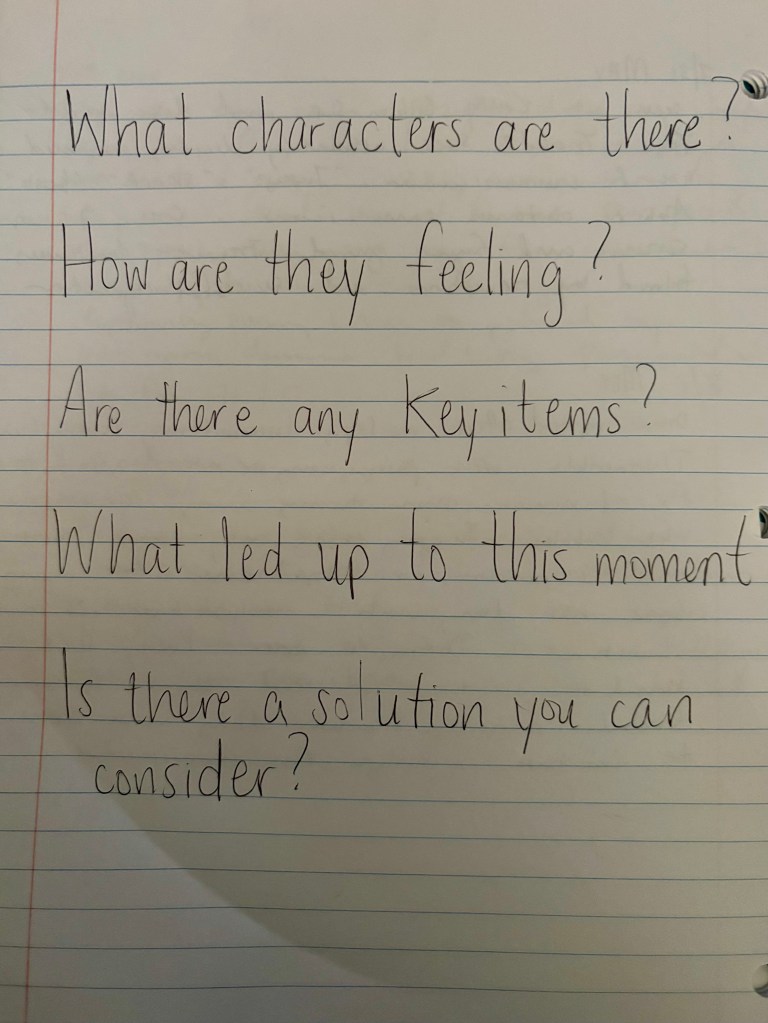
Given a situation picture card, Munch was able to come up with an introduction, a problem, and a solution. Questions that helped:

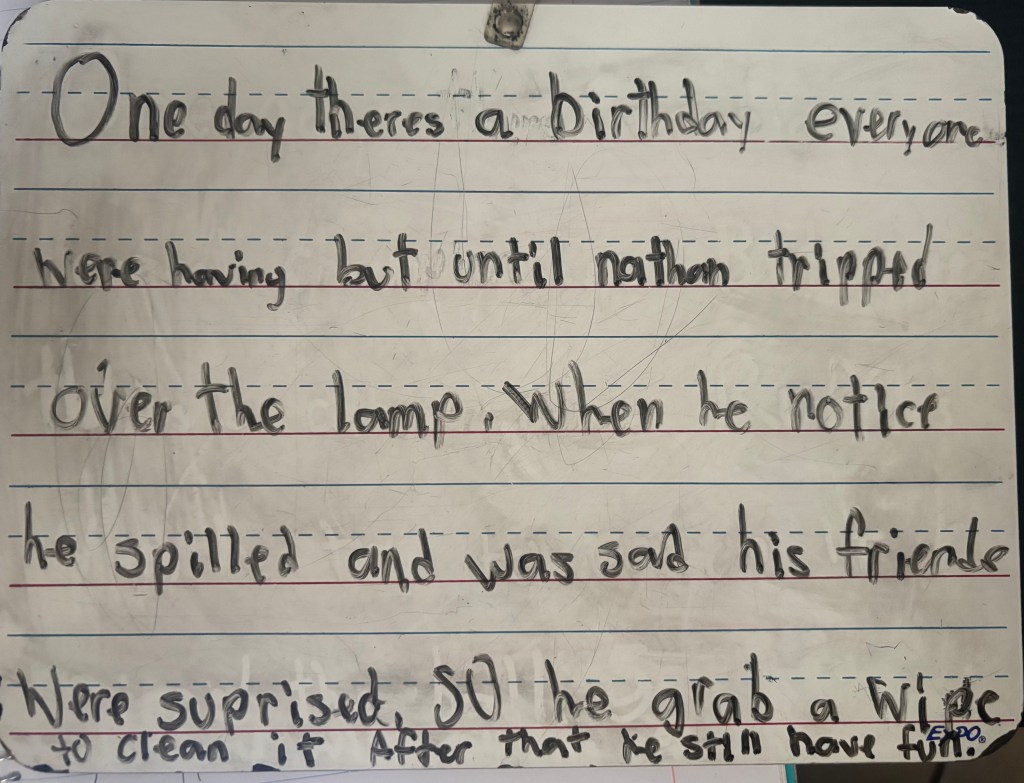
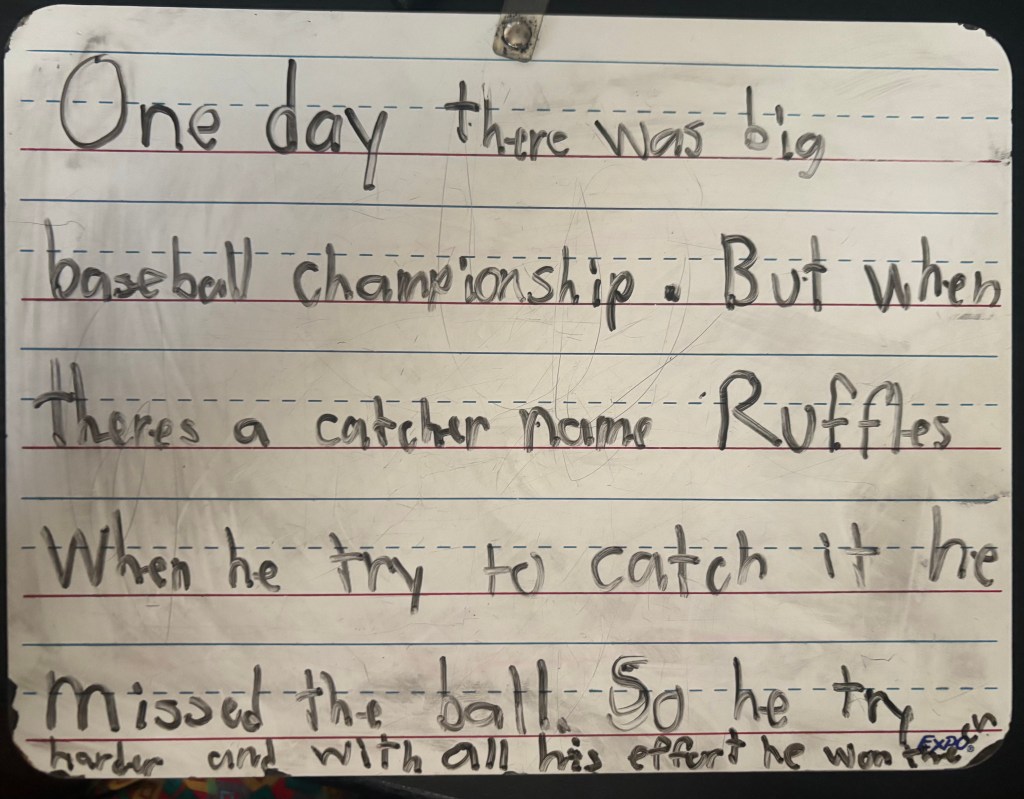
Munch surprisingly didn’t need much prompting to create these:

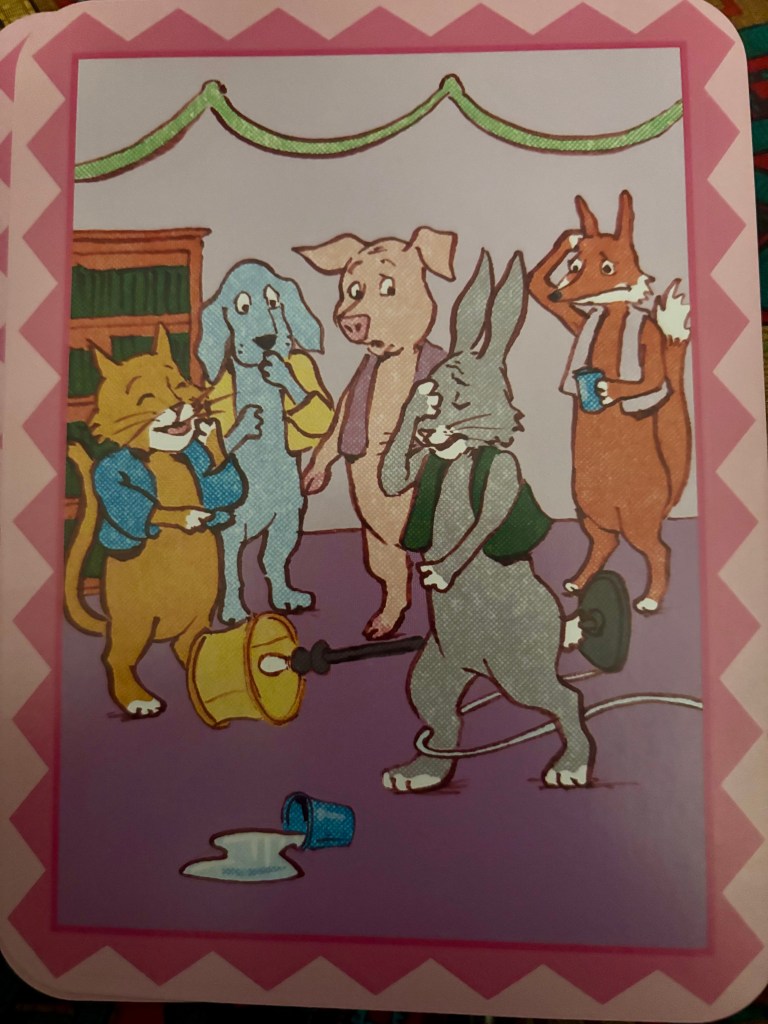
See if you can match the picture to the story:

These situation pictures are from a conversation card deck.

One of my favorite tools for identifying emotions, naming, finding problems, forming sentences, etc with this population. 

An additive includes using keywords, which I’ve pulled from a separate deck of individual words and using keywords in the story. Eg. chord, bingo, shame

There’s no reason for rhyme nor reason between the words – the more abstract, the more creative thinking the child is encouraged to use.

Another additive can be retelling a known story or using the picture to create a new ending or quality to the story. 

You always know I’m a few clicks away if you resonate with or want to know more about this therapy technique. Happy Treating!

Why Now?

“Tattletales of a Speech-Language Pathologist was borne from the deep-seated concern for the access to exposure in some areas of the field of speech-language pathology. In pursuing any area of the field, there are many visible resources for learning the A-Z on the etiology, assessment, and treatment of speech and language related disorders. In my experience, it was still the case that I felt under-prepared and under-informed. Walking into a room with a new patient is inevitably nerve-wracking for a new therapist or a therapist new to a specific disorder, population, or setting. Tattletales serves to tell the secrets of our biggest fears, before encountering them. It is a community for people like and unlike you, who have a common goal of providing a higher quality of service and reaching career milestones.”

This paragraph sat on the About Me page of this site for five years. For five years, this has been a place to feel “seen”, obtain new opportunities, and increase your confidence. But in that time, it hasn’t served its purpose in the fullness I had hoped.

I’ve worked for TEN companies in seven years. Ten facilities. Two telehealth screens. Six outreach efforts. Four countries. Three American cities. Four state licenses. Countless homes visited. Countless documents signed. Make. The numbers. Make. Sense.

To this day, I still feel the impact has not been sufficient. I woke up one day a year ago – jobless. And despite being on the road to a new home, my name was not on it yet and my home loan unfulfilled. Needless to say, life got scarier just then. Under-prepared and under-informed doesn’t end at the patient’s door nor the sliding exit.

Now, it’s more. It’s an attempt to bridge this community with the very service we’ve discussed over time, online and off.

Tattletales of a Speech-Language Pathologist is now Tattletales Speech and Early Intervention Services, PLLC. We are moving, shaking, and charging it to the game – I mean, to Blue Cross Blue Shield. With mobile and in-house services available, and while working alongside Yuma’s best of physical therapy and primary care and osteopathy at IMPT, we are hoping that more of the community can meet their needs.

This isn’t where fear ends, but it is where a new chapter begins.

Therapy Technique of the Week – Scaffolded Modeling

7/27/2025

This week, I’m recalling children I’ve worked with both in the homes as well as in the schools. Scaffolding is not just a great word; it summarizes what we do in pretty much every kind of therapy and as a part of educating ourselves and others. With an autism diagnosis, it’s likely that scaffolding actually looks far more intricate given the complexities of incorporating likes and dislikes, stimulation techniques, sensory needs, behaviors and regulation, and much more.

When it comes down to it, I’d compare it more to a tree coming into its own in the spring after a bare winter. When it sprouts a little leaf – well, that’s little Santiago using the word, GO! successfully.

After what’s been years of modeling such a common word, Santiago has only been able to – by his own volition – use the word as a result of incorporating his favorite toy monster truck with the screechy spinny wheels, which he would normally keep to himself just to finger slide the wheels repetitively about two inches from his face while laying otherwise still. God forbid any attempt to take it from him – three-hour meltdown.

If this sounds like any of your kids, you know what you need – rewards, first, and a saving grace of a branch that may sprout a leaf.

TLDR:

Scaffolded modeling – in this case – applies to the combination and graduation of familiar behaviors into what appears to be a positive outcome… for the child and others in their natural settings. With a new home health case this week, I performed a non-standardized evaluation with a child we’ll call Atty. Atty is non-verbal at four years old but very clearly tumble weeding information about his environments well enough to know what he can expect in the day-in-day-out-routine. He has difficult and dangerous maladaptive behaviors as a result of failing to meet these expectations. He also knows how to feed his sensory seeking personality and how to avoid what his senses perceive as the “bad guys”.

What works: Being the “good guy.”

Being the good guy means you are the source of what the child may be seeking. Thanks be to the Almighty if your child accepts touch, play items, things you can provide. But for some children, the best reward may be a break. Being the source of overwhelm is being “the bad guy” and can come with negative repercussions for the therapeutic process overall. Remember that autistic children rely on operant conditioning. Rapport-building is key to starting off on the right foot. Can you imagine a kid having the same distaste for you as a therapist as they do for soft bananas? Yeah.

What works: Creating new expectations.

This can be any combination of behaviors that works for the child, family, and your sessions. Be it starting with greetings, having a snack or shake-it-out break, having background music to aid in regulation, these are to yield more opportunities for success through clear expectations.

What works: Modeling smaller steps and rewarding each step

Some actions may seem simple enough to be imitated as-is. Bonding links, stacking blocks, etc. The outcome of a large castle or slinky snake is meant to be the “excitement” of it all — but why wait? By celebrating each step individually and more as the project progresses, a child is able to maintain interest and feel successful even if they don’t complete an activity.

What works: Carry over the bunch – the branch – to the next session.

A sign of solidified learning is “carry-over.” There is no promise for carry-over, right? Our children run the gamut of requiring the most manufactured realities, just to return some of the most unpredictable behaviors at times. Still, you as the provider carry-over what you know and can reasonably assume they know, to present greater opportunity for success. If the child’s mastered step one over the last several sessions, it might be a good time to add on – in your modeling – a secondary step which can only be understood as the result of or at least related to step one with the same positive outcome.

What works: Remove the steps and anticipate the behavior.

So, we spent all this time building a path to the positive outcome just to now have nothing for the child to rely on… not even a reward? Yes, but it doesn’t happen in just a day. You’ll likely spend just about as much time removing the scaffolding as you did building it. But that’s not always the case.

The child may find themselves using a behavior naturally in the setting, just because they’ve learned it’s accompanied by a good feeling. In other cases, you may have to decrease the reward (what used to be a snack, may now be a high five) or use a direction that feels familiar to them.

Either way, if at the end, a child is able to reach for the “excitable outcome” without much help or guidance, scaffolded modeling was successful.

If you have questions or comments about this therapy technique of the week, please write a note below or reach out via email at info@mytattletalesspeech.com.

Happy Treating.

Therapy Technique of the Week – Modeling Scaffolded Phrases

7/20/2025

This week, I’ve worked with two adult patients with long term effects of CVA (stroke) and subsequent apraxia of speech. Apraxia describes a deficit in the motor planning of speech. As a result, patients lose the ability to form words – even the ones that seem easy.

My two patients – we’ll call them Gin and Jack – are classically different. They don’t share the same gender, cultural traditions, upbringing, race, nor language. They’re also about 20 years apart in age. Yet, they share the same classical post-stroke symptoms and almost the exact same presentation in their language and speech output. Gin’s a bit more easily frustrated with her symptoms because she’s outgoing, while Jack is more of a “fly-solo” type of guy.

Either way, for both, being unable to form words definitely doesn’t ever get normalized, nor comfortable, and CVAs don’t play fair.

TLDR:

Scaffolding phrases. So, no, these do not have to be common phrases. With acquired apraxia, a common treatment method is using everyday phrases to rebuild the lexicon, essentially scanning the practiced phrases for use in a functional situation (i.e. Good morning, or I need help). Scaffolded phrases build the lexicon, as well, by structuring the different parts of speech to make useful sentences. First, the patient or therapist chooses an item in the immediate environment. Then, one word is combined with another word from another part of speech to make a partial phrase. Next, a longer phrase is created by adding additional parts of speech.

Example: Table. Wooden table. Brown wooden table. The brown wooden table broke.

This can be repeated as long as appropriate for the patient. After successful repetition at each level, the patient can move on to another single item to attempt to scaffold more phrases.

Note: Words are added to the beginning or end of already successful phrases. If a phrase is not successfully imitated, it is not reasonable to add more words. At the end, a complete sentence or thought with appropriate grammar is most useful, so it can be directly applied to communication. It is best to avoid scaffolding complex sentences or phrases that wouldn’t support that. For example, Broke the wooden table would leave out a necessary subject. Break the wooden table can be scaffolded to use in a longer phrase I broke the wooden table.

The phrases are not meant for memorization or rote practice, as they are with common treatment methods for apraxia. In fact, this approach can be considered more developmental in nature than restorative.

With Jack, I found it helpful to use a word-bank to facilitate more independence with scaffolding. I’d give him a word, and he would combine it with a word from the bank. It helps that he was literate after his stroke, which not all will be. As always, you meet the patient where they are. Modeling is key, and repetition is fundamental. When a patient has been asked one thousand times, What color is it?, the thousandth time they may likely have a better answer than I don’t know. By the thousandth time, the patient and therapist have built an understanding and reasonable expectations. By the thousandth time, the patient has accustomed themselves to using a strategy rather than giving up.

If you have questions or comments about this therapy technique of the week, please write a note below or reach out via email at info@mytattletalesspeech.com.

Happy Treating.

Red Tote Bag Chronicles

Like many speech-language therapists on the go, Miss Suleika holds a record trophy for the largest therapy bags to hit the road into home health. At the very least, I’d say about six months ago, I was carrying a trunk worth of materials. Fresh off the SNF train and overwhelmed with the telehealth-to-in-person transition, I thought I needed EVERY toy in Dollar Tree and book from the shelves of the library of little lambs within reach.

I couldn’t keep up with myself! The therapy bag was heavy, and the toy cleaning process was treacherous. My car was my moving toy and book store during the week and my reason to not carry a purse on the weekends. Fast forward to the new year, and I dropped that habit along with a good three quarters of my caseload.

The two events were mutually exclusive.

Now, I come therapy ready with my early intervention wardrobe and the simplest but brightest red recyclable tote bag with the bare ESSENTIALS. Inside of my tote bag:

2 4-inch monster trucks
4 children’s books
1 metal can with slot, and 24 plastic chips
1 bubbles

DASSIT.

I USED to carry a police car and fire truck combo instead of the monster trucks. Great, also, but beware of high stimulation and attachment. Sometimes, I couldn’t release these from the claws of my toddler clients. For the ones who were rather aggressive, the fie truck ladder was nothing but a base to swing the truck in a circle before sending it in flight across the room.

I like the bright red bag because it acts as a part of the language intervention itself. It provides structure – the child has attached this consistent visual stimulus (that’s not a face) to the therapist or the therapeutic activities, is expected to share a greeting prior to opening the bag, and some children will need to ask for help to access the bag, so that opening the bag and taking items out is a sort of reward for language use and play skills from the very moment the therapist enters the home.

The materials inside the bag don’t amount to the materials that are used, and on a day I’m moving items around in my stash, I may come across something nice to bring to a session. However, I depend most greatly on the items in the family’s homes to supplement my basic supply. WHY?

Obviously, the 2×30 mandate we meet for each child seems like a lot when it adds up to all of the other things in our schedules, but it’s less than a mere 3% – if even that – of the play, meal, and bath times the child experiences in a week long period at their homes or in their day care centers.

I realized with time, also, that most households have more than enough toys, puzzles, digital tools, and all what the Amazon marketplace has to offer for learning children. If they don’t have enough – encourage and educate as much as possible. I have brought toys and left them behind for families that simply could not, for whatever reason, stock their homes with materials to stimulate language.

For myself, it’s beneficial to have a lighter load, less waste and lost pieces from materials, and most-importantly easy cleaning and greater safety in a COVID-19 world.

Damsels in Direct Patient Care

It’s just like me to look at the calendar and realize not only is it the end of a month, but the end of the first quarter of the year! I’m beyond excited to place my last two cents on the last day of women’s history month, and celebrate all of the badass women that are making SLP the platforms of our hustler spirits.

Women have won the soft skills jobs fair and square… but this time around, it’s a bit different. While some of our seasoned professionals take the most pride in making speech smooth and the voice more pleasant to listen to… I take pride in our ability to:

• Spend the day caring for twenty times the amount of kids that some of us go home to every night.

• Listening to the same stories, in the same order, with the same pictures, and that same silly song.

• Juggle documentation like we’re performing for Medicare’s got Talent.

• Doing the stair stepper machine in scrubs and a labcoat for 8 hours of the day.

• Dress up in heavy spaceship gear and gather the forces of X-ray vision to perform MBSS

• Stand up tall to over-seasoned, salty, and stubborn MDs

• Risking it all to bring our tails to work to be essential in all the ways we never hoped for, and still ignored for the ways we do.

• Smile… constantly.. persistently… and effortlessly… 

I’m sure I’m not alone when I say, SLP busts my behind every day. And every day I choose to be a stronger professional, a more upright human being, a more fabulous woman, and a more dirty hustler.

This month, to me, is a great time to look back on what women chose to do that changed the world. It gives us more power to relinquish all doubt that we are indeed badass, worthy, and magical.

The Road to Behavioral Health

Littered with many changed plans and broken promises, I found a light at the end of a 4 month journey after leaving the SNF setting: Behavioral Health.

Might just be me, but who applies for jobs in bulk as a set it an forget it measure?

I do it, not often, but certainly enough to wrinkle my face in confusion when I get a rejection letter from a random research group at the University of Space Cadets saying that they’ll keep my information for future opportunities. I mean, I really didn’t have working in a hospital setting at all on my mind, and certainly not in psychiatry. When I left the SNF, I felt like my medical SLP persona was a day dying in the west, and all that was keeping topics like dysphagia alive for me were my reflections in my book and a couple (fake-it-til-you-make it) early intervention cases that brought feeding to the forefront, as well as my impostor syndrome.

I was no more versed on behavioral disorders than working with autistic adults from the scope of an SLP, yet I’d convinced myself that if I scooped up a double serving onto my plate that the confusion on both sides would cancel each other out.

I’ve had the passing thought at least weekly that group therapy is still alien to me… maladaptive behaviors (to such an extreme) are usually contra-indicated to the services I provide… and that psychosis is best left up to the psychiatrist and God – The SLP has no place in it.

But, with time and a lot of flexibility, I’ve been more glad to take my footing in a job for which I said I was only going to the interview for “fun”… and actually had so much fun that I came back for the long haul. When I met my team, I got that “when you know, you know” feeling, and it became all the more meaningful when I greeted my first patient.

So, all of my patients have intellectual disability. Nine times out of ten, they are autistic. Ten times out of ten, they are a colorful story waiting to happen.

No admission is the same, no day is the same as the last. So far, I’ve run the gamut of split personalities, girl drama, tantrums, food wars, in-house thrift shopping, property destruction, bullying, baby mama drama, attention-seeking, nudist tendencies, and hoarding, and paired most of these to some speechy activity to address them.

My life here is more interesting than anything I’ve ever experienced in a job setting, by far.

Join me, because we’re in for a crazy ride.

Self-published and Self-sabotaged?

This post is, really, an apology post.

Wherrreeee have you been, you may have been wondering? Maybe not. Either way, I’ve got to say, I hoped to be way more consistent than I’ve been.

This entire journey sprouted from the decision to self publish my book Tattletales of a Speech Language Pathologist: the CFY’s Guide to Surviving the Skilled Nursing Facility. Well since then, I’ve also decided on a self-led organization, self-funded toy drive, self-teaching in a new job position, and self-sacrificing in as many areas of life as I can name in a moment. In the least amount of words, I have bitten off far more than I can chew.

When I say “self” I should clarify that I haven’t been completely alone on any journey, and I’ve been glad to accept advice and assistance where it’s been offered. My publishing journey has been made much more light and easy with the laughs and stories shared between myself and my editor and new friend Melissa. Friends have shared in my joy and bought my book.

Still, achieving work-life balance has been inevitably impossible since I decided to bring SLP to the forefront in all of these different kind of ways. If you’ve known me for some time, or if you’ve read my book, you know how important mental health is to me. That being said, I want all of the things I do by my “self” to equate with the amount of things I do for myself.

If there’s one thing I’m going to always do it’s to give the real… I’m a storyteller, so naturally I try to entertain along the way. I’m not going to pretend, however, that underneath the giggles and creative prose, that there’s not a single thing left that gives me pause.

Loving, living, and thriving in this field is a choice. Loving, living, and thriving with self is a must. So, finding the balance is really the daily goal.

While it seemed to me that this may be achieved as a series of solo tasks, the truth is that a solid community might be the best way to structure around self- goals and needs.

That being said, I count on you to make this journey as meaningful as it was once intended.

I have a few questions:

How would you describe the community you currently are or want to be a part of?

How is this community helping you care for your self?

What tactics have you learned to achieve balance between your job and your calling?

Feel free to comment below or message privately.

Black is My History

I didn’t quite feel comfortable letting the last minutes of February slip by without saying something. As busy as life gets, and the farther we get from elementary school programs and poster boards, the more we have to attune to the real black history – not just the history that made us, but the history we’re making for generations to come. 

I know that for myself, there are two things I’ll always take pause for – race and religion. I’d say, smelling the roses isn’t quite the appropriate phrase, unless you imagine holding the thorned stem in clenched fists while breathing in what good the aroma that opposes the pain brings.

It’s taken all of this short month, but today is my turn to remind myself of all the subtle ways we put “power” into being Black.

Being a Black speech-language pathologist, a Black Latina, a Black Master’s grad, a Black writer, a Black snowboarder, a Black business, a Black … anything.

While it means so much more that we acknowledge how important it is to be Black in just about any space, we also acknowledge that the space was for some reason not made just right for us.

… or so it may seem.

If I were to describe my Black experience as an SLP, I’d say it’s been great.

Great?

Great. More than great. And it’s quite the surprise. I remember sitting in a white-dominated classroom in undergrad being taught about AAVE (newly referred to as AAE) and while my tongue usually prefers a more standard English, I was the professional on the topic with many blue and green eyes and dropped jaws unable to grasp the topic for what it really was.

I remember punching the air in grad school when I nearly failed an in-house clinical rotation, and a black supervisor gave me “the eye” and reminded me of what I needed to prove.

I remember being rejected reference letters because of my “demeanor”.

I thought for a while SLP might not offer much but proving myself time and time again.

Yet… somewhere along the way I was a little more self sufficient. I walked a little more confidently.

I embraced people in employment and academic settings that made me feel at home around them, which were not many.

I embraced mentorship that pushed me to be great because I needed to be great, and not because I needed to be great for a black person.

And now, I can say I have not worked in a single place that put me under the kind of pressure I was most afraid of: a place where the pressure rises around me each day to not be an outsider, to rise above each occasion, to be a socialite in the effort of accomplishing these things effectively.

Have I experienced any racism? Yes, once or twice with 95 year old dementia patients that loved me just as the hard the following day.

But, I have felt systematically safe. I’ve ensured, in my own way, that an imbalanced demographic would not stand in my way. Going back to my “interview tactics”, you don’t just bring YOU to the interview, you bring YOU to work every single aching day. I’ve turned down jobs, school acceptances, and anything else that I felt would lead to my discomfort or distraction with things other than what I came for.

I’ve realized with time, that I don’t have to do that. SLP has offered me something much greater than simply avoiding an uncomfortable situation – it’s given me peace in turmoil, resilience in chaos, the motive to serve, and the why? I am persistently trying to satisfy.

It’s still great to have the ability to see many people that look like me in high places – it’s a Black girl’s forever dream to have a Barbie doctor, dentist, or model with an afro. 

I’m somebody’s Barbie speech therapist – just with shorter legs and dreadlocks. I move at the beat of my own drum here. I take the roads less traveled. I follow ALL of my dreams.

So, when someone complains that they’re out of place in a white-dominated space… I just reflect on my own path and realize that community just makes us feel ourselves. It isn’t the source of power, though – that is from within.